
Meet the team


Steel & Coating Innovation
Developing advanced steel liner solutions capable of withstanding the demanding conditions of hydrogen storage in LRCs. The focus is on combining laser welding with Extreme High-Speed Laser Material Deposition (EHLA) to produce high-integrity welds and protective coatings that reduce hydrogen embrittlement and fatigue.
A key innovation is the integration of these processes into automated and potentially mobile manufacturing systems, enabling both efficient production and in-situ repair.
Key activities include:

Optimising EHLA process parameters to achieve defect-free, well-adhered coatings resistant to hydrogen embrittlement
Evaluating performance through hydrogen permeation, fatigue testing, and detailed microstructural analysis
Developing guidelines for steel grade selection, welding techniques, and coating strategies
Designing a mobile robotic platform integrating welding and coating for automated fabrication and repair
The goal is to deliver reliable, scalable steel liner solutions with enhanced durability and resistance to hydrogen-related degradation.

Concrete & Geological Systems
This work addresses the non-metallic components of LRC systems, focusing on low-carbon concrete and the interaction between concrete, rock, and steel. It explores how different geological conditions influence system performance and long-term stability.
By combining laboratory testing with advanced characterisation techniques, WP2 builds a comprehensive understanding of material behaviour under hydrogen exposure and cyclic loading.
Key activities include:
Developing and testing low-carbon concrete formulations as alternatives to conventional cement
Assessing durability under hydrogen exposure, including permeability and microstructural changes
Characterising rock properties across different lithologies and their impact on cavern performance
Investigating the behaviour of interfaces (rock–concrete–steel), including bonding, friction, and fatigue
One of the key objectives is to ensure the structural integrity and environmental sustainability of LRC systems across diverse geological conditions.

Simulation & Optimization
This work develops the digital backbone of the project, enabling detailed simulation and optimisation of LRC systems under realistic hydrogen storage conditions. We model the full system, including steel liners, concrete buffers, and surrounding rock, as well as their interactions under cyclic loading.
The models are calibrated using experimental data, allowing accurate representation of deformation processes, stress redistribution, and potential failure mechanisms such as fracture or leakage. In parallel, field-scale simulations are carried out for different geological scenarios, including coal mines, crystalline rock, and sedimentary formations.
Key activities include:
Modelling coupled behaviour of steel, concrete, and rock under cyclic loading
Calibrating simulations using experimental data
Assessing risks such as deformation, fracture, and leakage
Applying optimisation algorithms to improve design and operation
This aims to support safe, efficient, and optimised hydrogen storage design.

Advanced Monitoring
Develops a comprehensive monitoring framework to ensure safe and reliable operation of LRC systems over time. It combines advanced sensing technologies with predictive modelling to detect changes in system behaviour and assess conformance with expected performance.
Fibre-optic sensing technologies are deployed to monitor strain, temperature, and acoustic signals across the structure, enabling distributed and continuous measurements. These are complemented by 3D-printed sensors designed to detect corrosion and other localised effects in challenging environments. All monitoring data are integrated into digital twin models, allowing real-time comparison between predicted and observed system behaviour.
Key activities include:
Deploying fibre-optic sensing for strain, temperature, and acoustic monitoring
Developing 3D-printed sensors for challenging environments
Integrating monitoring data into digital twins
Detecting deviations and potential risks in real time
This ensures safe operation through continuous monitoring and early warning capabilities.

System Validation (TRL5)
Integrates and validates the full LRC system under realistic operating conditions, demonstrating the performance of materials, monitoring technologies, and simulation tools developed across the project.
Validation tests are conducted at two sites: facilities in Spain and the Mont Terri underground laboratory in Switzerland. These tests simulate real operating conditions, including cyclic hydrogen injection and withdrawal, and allow detailed assessment of system behaviour across different geological environments.
Key activities include:
Conducting validation tests in Spain and Mont Terri
Simulating real operational cycles of hydrogen storage
Evaluating system performance across geological conditions
Comparing measured data with simulation results
We will demonstrate system readiness and support future deployment.

Site Selection Toolkit
Translates technical and scientific results into practical tools that support the deployment of LRC systems across Europe. It focuses on identifying suitable locations for hydrogen storage and providing guidance for decision-makers.
A structured methodology is developed to evaluate site suitability based on geological, technical, environmental, economic, and regulatory criteria. These parameters are analysed using cross-impact methods to identify the most influential factors. The results are integrated into a GIS-based platform, enabling users to explore potential storage sites and assess their capacity and feasibility.
Key activities include:
Analysing geological, environmental, and economic factors
Developing a GIS-based atlas of potential sites
Creating decision-support tools and selection guidelines
This will enable informed, data-driven site selection.

Techno-Economic Analysis
This work evaluates the economic feasibility and system-level value of LRC-based hydrogen storage. It combines technical results with market modelling to assess costs, revenues, and business opportunities under different scenarios.
The analysis integrates hydrogen and electricity markets, allowing the project to assess how storage systems interact with energy supply, demand, and price dynamics. Different operational strategies are explored, including participation in hydrogen markets, electricity balancing, and hybrid use cases.
Key activities include:
Modelling hydrogen and electricity market interactions
Assessing different operational scenarios
Estimating costs, revenues, and profitability
This will define viable business models and support investment decisions for LRC.

Communication, Outreach & Exploitation
We aim to connect the project with industry, policymakers, researchers, and the wider public, while also preparing the ground for future uptake and exploitation of key results.
Key activities include:
Developing and implementing a Communication and Dissemination Plan, including KPIs and impact tracking
Creating the project’s visual identity, website, and communication materials (e.g. videos, factsheets, social media content)
Organising workshops, a summer course, and a final conference to engage stakeholders
Collaborating with other EU projects and participating in events, conferences, and clustering activities
Identifying key exploitable results and developing pathways for uptake, replication, and long-term impact
We ensure maximum visibility, uptake, and long-term impact of the project by ensuring that knowledge is shared, stakeholders are engaged, and results are translated into real-world applications.

Project Management
SINTEF leads the coordination, supported by a dedicated management team and the work package leaders. Together, they oversee day-to-day activities, strategic decision-making, and communication across the consortium.
A structured governance framework, including an Executive Board and Advisory Board, supports transparency, accountability, and continuous improvement.
Key activities include:
Coordinating daily project activities and aligning technical progress across all work packages
Managing administrative, financial, and reporting obligations to the European Commission
Implementing quality assurance procedures and reviewing project results
Monitoring risks and defining mitigation strategies throughout the project
Tracking progress against objectives, KPIs, and Clean Hydrogen JU requirements
Developing and maintaining a Data Management Plan and ensuring data integrity
This ensures that the project runs smoothly, delivers high-quality results, and achieves its objectives within time, scope, and budget.

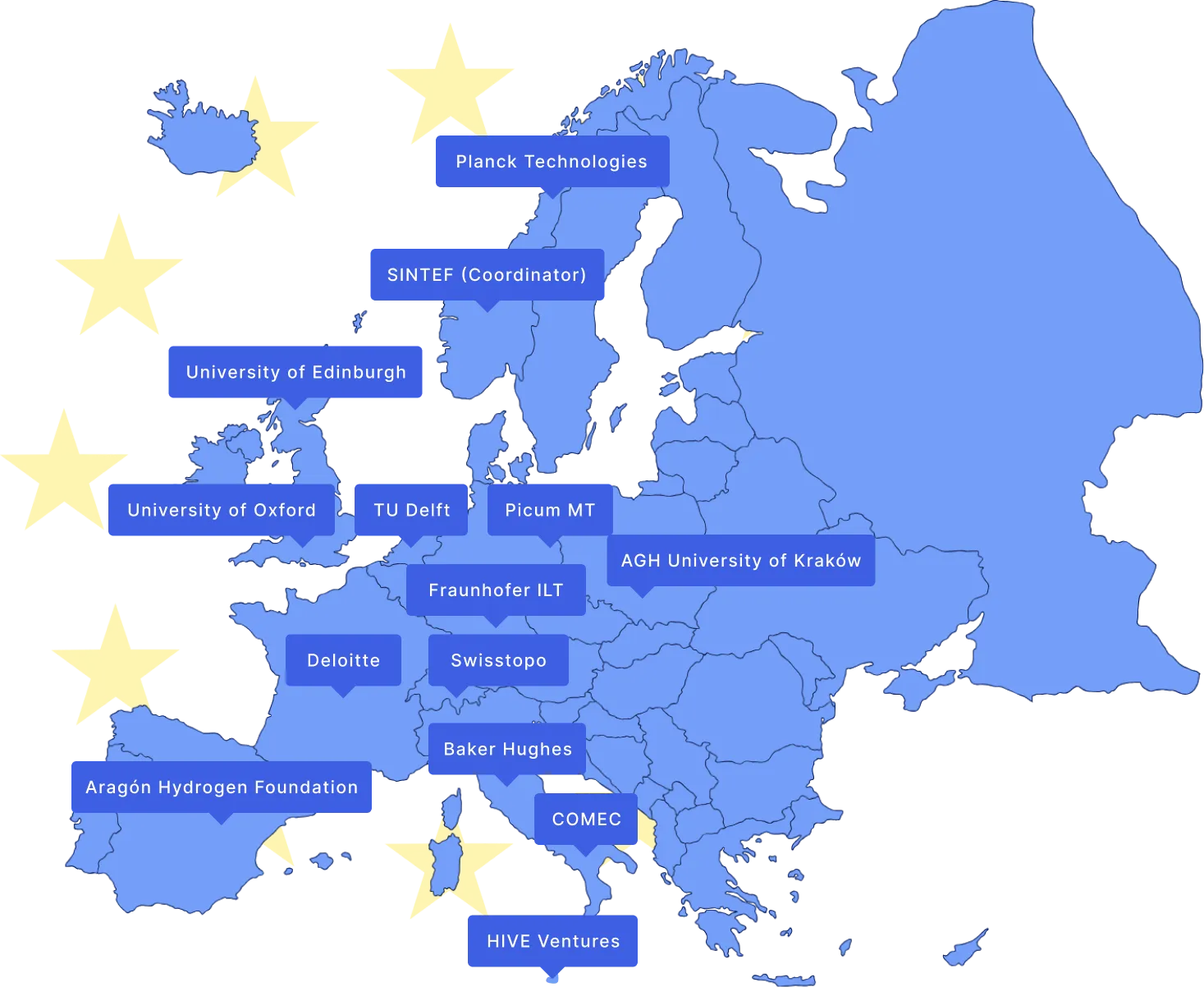

SINTEF (Coordinator)
SINTEF is Scandinavia’s largest independent research organisation and leads the project. It has extensive experience in hydrogen and CO₂ storage, as well as geomechanics, geochemistry, and geophysics. The institute has coordinated major European research initiatives and plays a central role in advancing energy solutions for the transition to a low-carbon economy.
Within the project, SINTEF oversees coordination and contributes to monitoring, modelling, and validation activities. It also provides access to advanced research infrastructure, including hydrogen laboratories in Trondheim, supporting both experimental work and real-world testing.

Fraunhofer ILT (FILT)
Fraunhofer ILT is part of the Fraunhofer-Gesellschaft, Europe’s leading applied research organisation. The institute is internationally recognised for its expertise in laser technologies and is the originator of the EHLA process used in this project for advanced coatings.
In the project, FILT focuses on developing laser-based manufacturing solutions for steel liners, including welding and coating technologies. Its work ensures high-quality, scalable processes that are suitable for industrial deployment in hydrogen storage systems.

TU Delft (TUD)
The Delft University of Technology is one of Europe’s leading engineering universities and a pioneer in hydrogen research and underground storage modelling. It is known for developing open-source simulation tools and advancing digital approaches to energy systems.
In the project, TU Delft leads the development of numerical models to simulate LRC behaviour under real operating conditions. Its work supports design optimisation, risk assessment, and the integration of experimental data into predictive tools.

AGH University of Kraków (AGH)
AGH University is a multidisciplinary institution with strong expertise in engineering, geosciences, and environmental studies. Its teams specialise in subsurface systems, fluid flow modelling, and the design of energy technologies.
Within the project, AGH contributes to site selection and system assessment, helping to evaluate geological conditions, risks, and environmental factors. Its work supports the development of practical tools for identifying suitable hydrogen storage locations.

Aragón Hydrogen Foundation (FHa)
The Aragón Hydrogen Foundation is a non-profit organisation dedicated to advancing hydrogen technologies for clean energy. It operates specialised facilities for hydrogen production, storage, and testing, including large-scale infrastructure.
In the project, FHa leads validation activities, providing real-world environments where technologies can be tested under realistic conditions. Its role is key in demonstrating how hydrogen storage systems perform in practice.

University of Edinburgh (UEDIN)
The University of Edinburgh’s School of Geosciences is recognised for its work on geological storage of hydrogen and CO₂. Its research focuses on how hydrogen interacts with rocks and engineered materials, and how storage systems perform over time.
In the project, UEDIN develops and tests low-carbon concrete materials and studies their behaviour under hydrogen exposure. It also contributes to policy-related aspects through its expertise in carbon capture and storage.

HIVE Ventures (HIVE)
HIVE Ventures supports innovation and sustainability projects by connecting partners, expertise, and funding opportunities. It works with organisations across research, industry, and the public sector to deliver impactful solutions.
In the project, HIVE leads communication, dissemination, and exploitation activities. Its role is to ensure that results are clearly communicated, widely shared, and translated into practical outcomes that can be used beyond the project.

COMEC
COMEC is an engineering company specialising in advanced manufacturing systems and automation. It develops customised industrial solutions and collaborates with leading technology providers across different sectors.
Within the project, COMEC contributes to the development of innovative components and sensor technologies. Its expertise supports the integration of monitoring systems and the design of solutions for hydrogen storage infrastructure.

Baker Hughes (BKR)
Baker Hughes is a global energy technology company with a long history of developing solutions for complex energy systems. It brings expertise in subsurface modelling, materials science, and industrial-scale engineering.
In the project, Baker Hughes contributes to geomechanical simulations and the study of hydrogen-related material behaviour. Its work supports both system design and the assessment of long-term performance under operational conditions.

Deloitte (DLT)
Deloitte is a global advisory firm with strong expertise in energy economics and policy analysis. Its teams support decision-making by combining technical knowledge with market and regulatory insights.
In the project, Deloitte leads the techno-economic assessment, analysing costs, market opportunities, and business models for hydrogen storage. Its work helps determine how these systems can be deployed at scale.

University of Oxford (UOXF)
The University of Oxford is a leading research institution with strong expertise in energy materials and hydrogen technologies. Its work focuses on understanding how materials behave in demanding environments.
In the project, Oxford studies hydrogen interactions with metals and coatings, including processes such as embrittlement and degradation. This research helps improve material performance and supports safer storage solutions.

Planck Technologies (PLT)
Planck Technologies is a deep-tech company developing innovative hydrogen storage solutions based on adsorption technologies. Its approach focuses on scalability, efficiency, and practical deployment.
Within the project, Planck contributes to the development of guidelines and standardisation approaches. Its work helps translate technical results into solutions that can be applied across different sites and use cases.

Swisstopo
Swisstopo is Switzerland’s national centre for geoinformation and operates the Mont Terri Rock Laboratory, a leading underground research facility. It provides expertise in geological data and subsurface experimentation.
In the project, Swisstopo supports validation activities by facilitating access to the Mont Terri site and contributing to the design of experiments. Its role ensures that testing is carried out under realistic underground conditions.

Picum MT (Picum)
Picum MT is a specialised engineering company focused on mobile machining and advanced manufacturing solutions. It develops systems designed to operate in complex and constrained environments.
In the project, Picum contributes to the design of a mobile robotic platform for steel liner fabrication and repair. Its work supports automation and scalability in the construction of hydrogen storage systems.